







A definitive B2B guide by DVNJEWELRY® — sustainable custom jewelry manufacturing since 1944.
The 30-Second Answer
Three words on a product page. Three completely different products in a customer's hands.
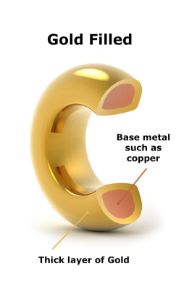
Gold Vermeil is a minimum of 2.5 microns of 10kt+ gold over solid sterling silver. Gold-Filled is a thick gold sheet — 5% of the total weight (1/20), heat-bonded to a core. Gold-Plated is a micro-thin film of roughly 0.175 microns over a base metal. One lasts for decades. One is measured in weeks.
If you are a brand, a wholesaler, or a private-label buyer, the difference between these three isn't academic. It decides your return rate, your review scores, your repeat-purchase rate, and whether your marketing claims survive contact with a regulator. This guide breaks down all three the way a manufacturer sees them — so you specify the right one before you place a single order.
Why This Matters More Than Brands Realize
A customer cannot see microns. They can only see the ring on their finger three months later — still luminous, or already showing base metal at the edges. That single experience becomes a five-star review or a refund request. Multiply it across a season, and your choice of gold layer quietly determines the health of your brand.
The problem is that "gold" is used loosely across the industry. The same photograph can sell vermeil, gold-filled, or plated — but the cost to manufacture, the durability, and the legal marking requirements are worlds apart. Brands that understand the distinction command higher prices with confidence. Brands that don't inherit the returns.
At DVNJEWELRY, we manufacture across all three constructions, so we have no incentive to sell you one over another. We only have an incentive to make sure the label on your product matches what's actually inside it.
Gold Vermeil: Solid Gold Over Sterling Silver
Vermeil (pronounced ver-may) is the luxury choice for demi-fine brands, and it is the most tightly regulated of the three.
Under the U.S. FTC Jewelry Guides, a piece can only be called vermeil when a base of sterling silver (.925) is coated with gold of at least 10 karat fineness, at a thickness of no less than 2.5 microns. Two conditions, both mandatory: the core must be genuine sterling silver, and the gold layer must meet that minimum thickness. Anything thinner, or any base metal other than sterling silver, is not vermeil — it is plated.
Why brands choose it: vermeil carries a precious-metal core, so it is hypoallergenic-friendly, holds its color beautifully, and can be marketed honestly as a fine-jewelry-adjacent product. It sits in the sweet spot between the cost of solid gold and the fragility of plating.
What to specify: thickness (2.5 microns is the floor — premium houses go to 3–5 microns), gold karat (14kt and 18kt read as more luxurious than 10kt), and confirmation of a true .925 base. At DVNJEWELRY we produce vermeil at a premium 2.5-micron standard on genuine sterling silver.
Gold-Filled: The Quiet Workhorse of Serious Brands
Gold-filled is the most misunderstood — and, for many brands, the smartest — construction on this list.
The FTC standard requires that the gold represent at least 5% of the item's total weight (expressed as 1/20), in a layer of 10 karat or finer, mechanically bonded to a base core. That "bonded" word is the whole story. Gold-filled isn't dipped or sprayed; a genuine sheet of gold is fused to the base under heat and pressure until it is physically part of the piece.
The result is a product that behaves far more like solid gold than like plating. It resists tarnish, survives daily wear, and can last decades without exposing the core — which is exactly why gold-filled dominates the "everyday luxury" and waterproof-jewelry categories that are winning online right now.
Where DVNJEWELRY specializes: unlike ordinary electroplated jewelry, we manufacture heat-bonded gold-filled pieces — the durable construction that lets a brand promise longevity and actually keep the promise. For direct-to-consumer brands built on reviews and repeat purchases, this is often the highest-margin decision you can make, because it slashes returns.
Gold-Plated: Beautiful, Affordable, and Honest About Its Limits
Gold-plated jewelry has a place — fast-fashion drops, trend pieces, seasonal collections, price-sensitive lines. It simply needs to be sold as what it is.
To be legally marked "gold plate" or "gold electroplate," a piece needs an electroplated layer of 10kt+ gold at a minimum of 0.175 microns. In practice, much costume plating is even thinner. Because the gold film is measured in fractions of a micron, it will eventually wear — the only question is how fast, which depends on thickness, wear, skin chemistry, and care.
The strategic use: plating lets a brand hit aggressive price points and test designs before committing to vermeil or gold-filled production. The mistake is marketing plated goods with fine-jewelry language and longevity claims they can't support. That gap is where refund requests and one-star reviews live.
Side-by-Side: How the Three Compare
| Gold Vermeil | Gold-Filled | Gold-Plated | |
|---|---|---|---|
| Core / base | Sterling silver (.925) | Brass / base metal | Brass / base metal |
| Gold layer | ≥ 2.5 microns | 5% of total weight (1/20) | ≈ 0.175 microns |
| Minimum karat (FTC) | 10kt+ | 10kt+ | 10kt+ |
| How gold is applied | Electroplated (thick) | Heat / pressure bonded | Electroplated (thin) |
| Typical lifespan | Years | Many years / decades | Weeks to a couple of years |
| Best for | Demi-fine, luxury gifting | Everyday luxury, waterproof lines | Fashion, trend, entry price points |
| Positioning | Fine-jewelry adjacent | Premium everyday | Accessible fashion |
Which One Should Your Brand Manufacture?
There is no universally "best" construction — only the right fit for your positioning, price, and promise.
Choose vermeil when your brand sells on prestige and a precious-metal core, and your customer expects demi-fine quality. Choose gold-filled when you're building on longevity, waterproof claims, and repeat purchases — the review-driven DTC playbook. Choose plated when speed-to-market and price are the point, and your marketing stays honest about it.
The costliest error we see is a mismatch: a brand markets like vermeil, prices like gold-filled, and manufactures like plating. The customer notices in ninety days. A good manufacturer stops that mismatch before it reaches production — matching the construction to the story you're actually telling.
A Note on Compliance (Because It Protects Your Brand)
The FTC micron and karat thresholds above aren't manufacturer preferences — they govern what you are legally allowed to print on a hangtag, a listing, or an ad in the U.S. market. Marking a plated piece as "vermeil," or a thin electroplate as "gold-filled," is a marketing liability, not a shortcut.
This is where manufacturing and marketing meet. When your factory documents karat, thickness, and construction on every order, your claims are defensible and your brand is protected. That documentation should come standard.
The DVNJEWELRY Standard
Since 1944, DVNJEWELRY has manufactured across every one of these constructions — solid gold from 6kt to 22kt, 925 sterling silver, premium 2.5-micron gold vermeil, and our specialty heat-bonded gold-filled — for brands, wholesalers, designers, and private labels across North America, Europe, Australia, the Middle East, and Asia.
Everything is produced in-house at our solar-powered, women-led facility, under strict NDA, with flexible MOQs for startups and enterprise programs alike. When you specify a construction with us, that's exactly what ships — documented, hallmark-coordinated, and export-ready.
Building a collection and want the construction matched to your positioning? Connect with a manufacturing expert or request a quotation. We'll help you specify the right gold — before you place the order.
Frequently Asked Questions
Is gold vermeil better than gold-filled?
Neither is universally better. Vermeil has a precious sterling-silver core and a luxury positioning; gold-filled typically wears longer because its gold layer is thicker and heat-bonded. For everyday, high-durability pieces, gold-filled often outlasts vermeil; for demi-fine prestige, vermeil leads.
How long does gold-plated jewelry last?
It varies with plating thickness, wear, and skin chemistry — commonly from a few weeks to a couple of years before the gold film shows wear. Thicker electroplating and gentle care extend it.
What does 1/20 14K Gold-Filled mean?
It means the gold layer is 14kt and makes up 1/20 (5%) of the item's total weight — the FTC minimum for the "gold-filled" designation.
Can gold-plated jewelry be called vermeil?
No. Vermeil legally requires a sterling-silver base and at least 2.5 microns of 10kt+ gold. Plating over base metal, or under 2.5 microns, cannot be marked as vermeil.
Which gold type is best for a new jewelry brand?
It depends on positioning. Brands built on longevity and repeat purchases usually favor gold-filled; prestige demi-fine brands favor vermeil; trend-led or price-sensitive lines use plating. A manufacturer can help match construction to your brand promise.
DVNJEWELRY® is the global marketing identity of DVNTRADERS, the export division of DVNGROUP — a sustainable custom jewelry manufacturer since 1944.
Leave your comment